If it weren’t for the invention of the sewing machine, this work might never have come into being. When Isaac Singer died, his daughter Winnaretta Singer—later Princess Edmond de Polignac—inherited a fortune from the Singer sewing machine empire. She went on to become one of the most prominent patrons of Parisian cultural life and, in the mid-1930s, commissioned Francis Poulenc to write a work for organ and small orchestra. The result was the Concerto for Organ, Strings, and Timpani. The Princess herself was a passionate organist and owned a magnificent Cavaillé-Coll organ in her Paris salon. For the premiere, however, she left the solo part to organist Maurice Duruflé.
The Princess was more than simply the work’s patron. Through her, we glimpse the world in which Poulenc lived and worked—a world of private salons, artistic patronage, and Parisian high society at the center of Paris’s vibrant cultural life.
Born in Paris in 1899, Francis Poulenc first came to prominence as a member of Les Six, the loosely affiliated group of French composers that emerged after the First World War in reaction against the emotional weight of Romanticism and the hazy sound world of Impressionism. Yet Poulenc always remained an individual voice. Rather than embracing the strict doctrines of musical modernism, he preferred clarity of form, memorable melodies, and a direct, expressive musical language. Neither radical atonality nor rigid theoretical systems held much appeal for him. His music is marked by elegance, emotional depth, and immediacy. He first made his name with his witty stage works and ballet scores.
During the 1930s, however, Poulenc’s style profoundly changed. Following a series of personal crises, including the accidental death of a close friend, he returned to the Catholic faith. Works of great spiritual depth appeared alongside his secular compositions. His friend Claude Rostand famously described him as “half monk, half street urchin.”
These personal and artistic developments found expression in the Organ Concerto. Poulenc himself wrote in a letter that this was no longer the work of the “amusing Poulenc,” but of a Poulenc “on his way to the monastery.” At the same time, Europe was moving ever closer to the Second World War, as political uncertainty and social upheaval cast a growing shadow over the continent. Rather than responding with political statements, Poulenc expressed these tensions through music—music that is at once serious and ironic, sacred and worldly, monumental and deeply intimate.
The combination of organ, timpani, and strings can also be heard as a musical self-portrait of the composer. Poulenc was a man of many contradictions: deeply religious yet thoroughly worldly, melancholic yet humorous, unpretentious and highly cultivated. He combined joie de vivre with a taste for solitude. As much as he relished the excitement of Paris and its artistic circles, he also cherished the peace and quiet of his country retreat outside the city.
The organ represents grandeur, tradition, and spiritual depth, while the strings provide a fluid and versatile sound world. The absence of wind instruments is deliberate: Poulenc did not want an orchestral richness that would compete with the organ, but rather a carefully balanced dialogue between organ, strings, and timpani, in which each element retains its own distinctive color. The timpani, meanwhile, play a surprisingly important role. Hardly has the organ presented its opening theme before the timpani enter, establishing both the pulse and the key, reinforced by the pizzicato double basses. As the work unfolds, they alternate between ominous rumblings and dramatic strokes that signal major transitions, before falling completely silent as the music moves into intimate, lyrical passages. Although composed as a single movement, the concerto unfolds in seven interconnected sections. Its principal theme—a driving motif in G minor, characterized by the chromatic descent G–F♯–F–E–E♭—is introduced in the Allegro giocoso and returns throughout the work in different forms and keys. We hear the “Queen of Instruments” at times powerful and majestic, at others introspective and restrained.
The private premiere took place on December 16, 1938 in the salon of Princess de Polignac, conducted by Nadia Boulanger. The first public performance followed on June 21, 1939 at the Salle Gaveau in Paris. Today, the concerto is regarded as one of the most beloved works for organ of the twentieth century. Thanks to the sewing machine.
Jakob Biesterfeldt (Cello)
A Conversation with the Composer
Gustav Berger (oboe): Bernhard, we’re so happy that you wrote Am Humorgalgen for us. How did you first get involved with the Abaco Orchestra?
It all started through your conductor, Ina Stoertzenbach, whom I met years ago during my student days in Munich at an apartment jam session. Then, in 2022, I wrote a piece (14bis19) for the German National School Orchestra, and Ina conducted the premiere. We lost touch for a while after I moved from Munich to Cologne. But in 2025—just as I happened to reach out to Ina because I was looking for new projects—she suggested that Abaco commission me to write a new work.
What exactly was the commission, and what was your original idea for the work?
The only real brief was to write a work for orchestra and organ, about ten to fifteen minutes long, that would allow Abaco to explore new sounds or playing techniques. Ina also mentioned that it might be nice to give the winds and brass a bit more to do, since they don’t get to play the Poulenc. When I first sat down to write, I had the classic image of “romantic heartbreak” in mind. As a musician, I’ve always had a soft spot for Romanticism. But because contemporary classical concerts have often struck me as rather serious lately, I really wanted to write something on the lighter side. At one point, I even considered calling the work Die Welt am Humorgalgen (“The World at the Gallows of Humor”), but in the end it felt a little over the top and no longer conveyed the sense of playful parody I was after.
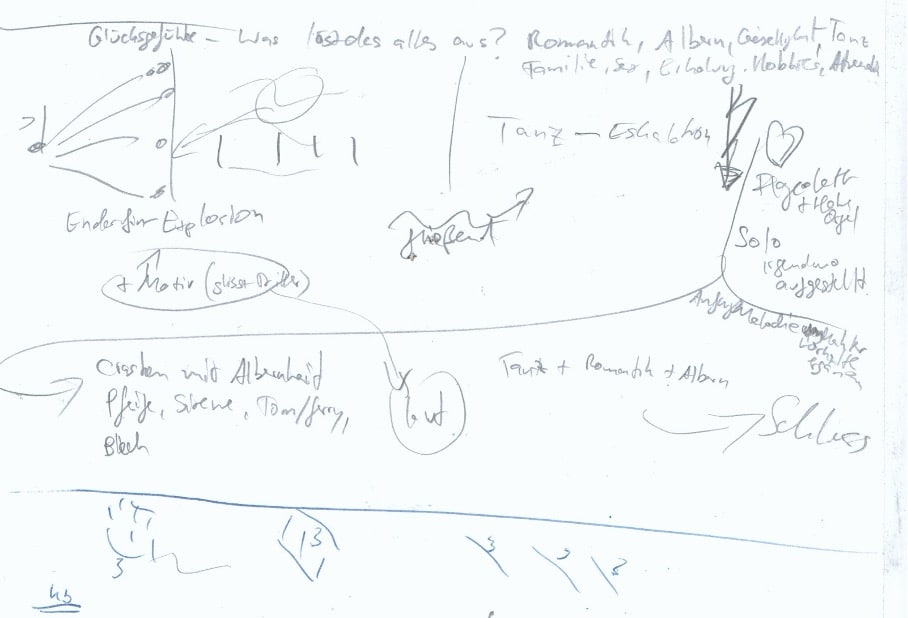
How did you begin working on the piece?
I started by writing down words that evoke positive emotions for me: romance, silliness, dancing, family, relaxation, eroticism, and so on (see the composer’s notes above). From there, I experimented at the piano with sound clusters that gradually developed into four main motifs. Every melody in the piece ultimately grows out of the trumpet’s fast rhythmic motif at the very beginning—the opening section, “Feuer frei!”
So how does that become the “Humorgalgen?”
Melodic developments are constantly interrupted, creating clearly defined sections with distinct characters—silliness, dance, sarcasm, etc. Running through the entire work is a recurring musical joke: a strange blend of Petrushka—the tragic puppet from Russian fairgrounds, immortalized by Stravinsky—and a rabid clown wielding a hammer. The common thread is exaggeration. Imagine someone who’s sad but laughs hysterically through the pain, or someone who’s constantly being told, “Relax already!”—does that actually help anyone relax? That’s essentially where gallows humor begins—or, in this case, where you find yourself hanging “at the gallows of humor.” Moments of genuine lightness do appear, but only every now and then.
You also ask us to improvise over predetermined pitches.
Yes—that’s the “Sound Bath” section, which follows the opening “Feuer Frei!” Classical musicians aren’t used to improvising. Harmonically, the piano introduces the underlying sound cluster beforehand, and rhythmically it provides a steady pulse that gives structure to the improvisations. For the organ, I also included a number of very specific sound requests in the score. In Zurich we’ll be using an organ whose sounds can be programmed by computer, so it’s capable of producing all sorts of unusual timbres. The question, of course, is whether the same effects will work on a purely mechanical organ in Munich. At least they work perfectly in my head! (laughs) I’m very curious to hear how they’ll sound live.
The third section is called “Dösbaddelig,” and the piece ends with “Swing Feel.” Where do these stark contrasts come from?
The Sound Bath can certainly be calming—but it’s also a bit like someone standing over your shoulder saying, “Now relax!” The section called “Dösbaddelig” is like a barrel organ: basically romantic and soothing, but gradually spiraling into hysterical exaggeration. It’s a kind of beauty that simply isn’t allowed to exist in peace.
When I sent Ina the final section, I told her, “Now the horses are running away with me.” I wanted to push things to the limit—a bit of slapstick, really. It has a bit of a Donald Duck vibe.
Thank you so much for your time!
— Intermission —
Camille Saint-Saëns was born in Paris on October 9, 1835 and died in Algiers in 1921. He entered the Paris Conservatory at the age of thirteen, where he studied piano, organ, and composition. In 1852, he accepted his first permanent position as organist at Saint-Séverin Church in Paris. That same year, he met Franz Liszt, whose influence would shape his musical development for years to come. Liszt famously called Saint-Saëns “the greatest organist in the world.” In 1857, Saint-Saëns became principal organist of the Église de la Madeleine in Paris. His improvisations, in particular, drew large audiences—many people came as much for the music as for the liturgy. Even Clara Schumann and Pablo de Sarasate traveled to Paris to hear him perform. Saint-Saëns composed his Third Symphony in 1885–86 on commission from the Philharmonic Society of London.
Formally, the symphony consists of two large movements, each of which can be divided into two traditional symphonic movements. In this respect, it invites comparison with Liszt’s Piano Sonata in B minor, itself written as a single continuous movement that nevertheless encompasses the functions of four. Saint-Saëns had originally intended to compose the symphony in B minor as well, but later joked in a letter to Francesco Berger, Honorary Secretary of the Philharmonic Society: “This wretched symphony has slipped up by a semitone; it refused to stay in B minor and now finds itself in C minor.”Like Liszt, Saint-Saëns builds the entire work from a small thematic cell. At its core is a motif that strongly recalls the Gregorian Dies irae chant. He ultimately dedicated the symphony to Franz Liszt as well, a further testament to the close artistic bond between the two composers.
The first movement consists of an Allegro moderato, preceded by an Adagio introduction, followed by a Poco adagio. The Allegro moderato broadly follows sonata form, although the development section breaks off unexpectedly. After a brief silence, the Poco adagio begins. The Dies irae motif appears almost immediately in the strings, although each note is repeated in rapid sixteenth notes before the melody continues, making the reference easy to miss on first hearing. The motif becomes more unmistakable when it later appears in the trombones. Repeating its opening four times, they grow increasingly powerful and ominous together with the orchestra before giving way to a brighter F major. The Dies irae then returns quietly in the strings, this time transformed into the major mode and set in eighth notes. The various forms of the motif heard so far are developed until the music suddenly breaks off and the Poco adagio begins with the organ’s first entrance in the symphony.
The Poco adagio serves as the emotional center of the symphony. For much of the movement, the organ plays a largely accompanying role, occasionally adding brief melodic phrases of its own. About halfway through, the Dies irae returns in the pizzicato of the lower strings and is briefly echoed by the organ before the violins once again unfold a lyrical melody above it. At this point, the organ is marked to use the voix céleste (“heavenly voice”) stop, whose shimmering sonority resembles an ethereal string sound.
The second movement opens with an Allegro moderato, driven by a sweeping theme in the strings reinforced by the timpani. This leads into a Presto whose thematic material subtly recalls the opening Allegro moderato of the first movement. The piano also enters here for the first time, another distinctive feature of the symphony’s orchestration. After the return of the movement’s opening theme, the Presto resumes and immediately introduces a new melody in the lower strings and horns, which later becomes the subject of the ensuing fugue. Toward the end, the Dies irae motif appears one final time in the lower strings in the minor mode, while the woodwinds conclude in G major. As the final chord resonates beneath a fermata, the organ enters fortissimo in radiant C major, marking the beginning of the fourth and final section of the symphony, the Maestoso.
At first, orchestral passages alternate with powerful organ chords before the principal theme of the final section emerges—another Dies irae variation, now quietly stated in the major mode and uniquely orchestrated. The four-hand piano part weaves shimmering sixteenth-note arpeggios above the melody in the strings, creating an almost celestial sonority, while the organ and timpani provide harmonic support in the lower register. The theme then returns in full force, now played by the entire orchestra. Trumpet fanfares, together with cymbals and bass drum, further emphasize the majestic character of the movement. The ensuing fugue begins by developing the theme before being interrupted by a pastoral melody in the woodwinds. From there, the pastoral theme and the major-mode Dies irae variation alternate and build upon one another, driving the music toward its monumental climax.
Maximilian Schinke (Timpani)
I. Adagio – Allegro moderato; Poco adagio
II. Allegro moderato – Presto; Maestoso – Allegro
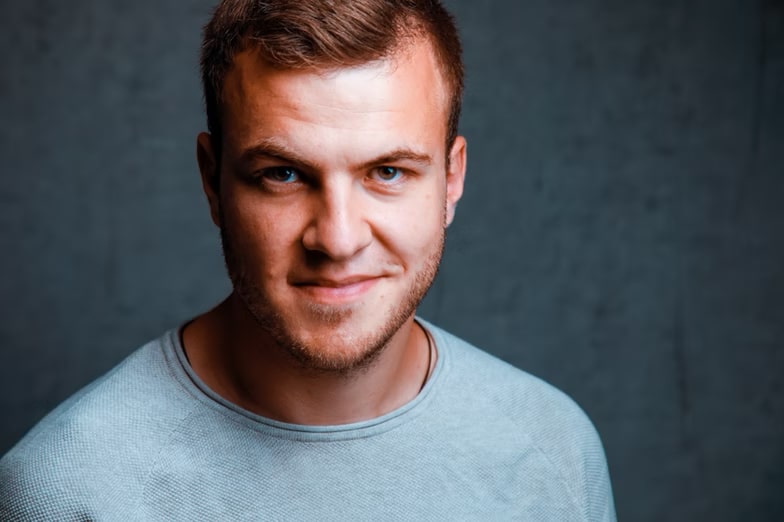
Bernhard Plechinger (*1994) is a young composer currently based in Cologne, Germany. In 2023, he completed his Master’s degree in Composition at the University of Music and Performing Arts Munich (HMTM), where he studied with Prof. Moritz Eggert. He also attended courses with Dr. Stefan Hakenberg and Prof. Georg Friedrich Haas, and received important artistic inspiration from Prof. Gerhard Müller-Hornbach and Prof. Markus Hechtle.
In his work, Bernhard Plechinger does not confine himself to any particular genre, but instead focuses on the ideas and content he wishes to convey.
His oeuvre includes music theatre, orchestral and chamber music, choral works, and numerous art songs. His compositions have been performed internationally by professional ensembles—including the HR Symphony Orchestra, Ensemble Musikfabrik, and the Prague National Chamber Philharmonic—and at festivals such as the European Weeks Festival Passau, the Gustav Mahler Music Weeks Toblach, and the aDevantgarde Festival Munich.
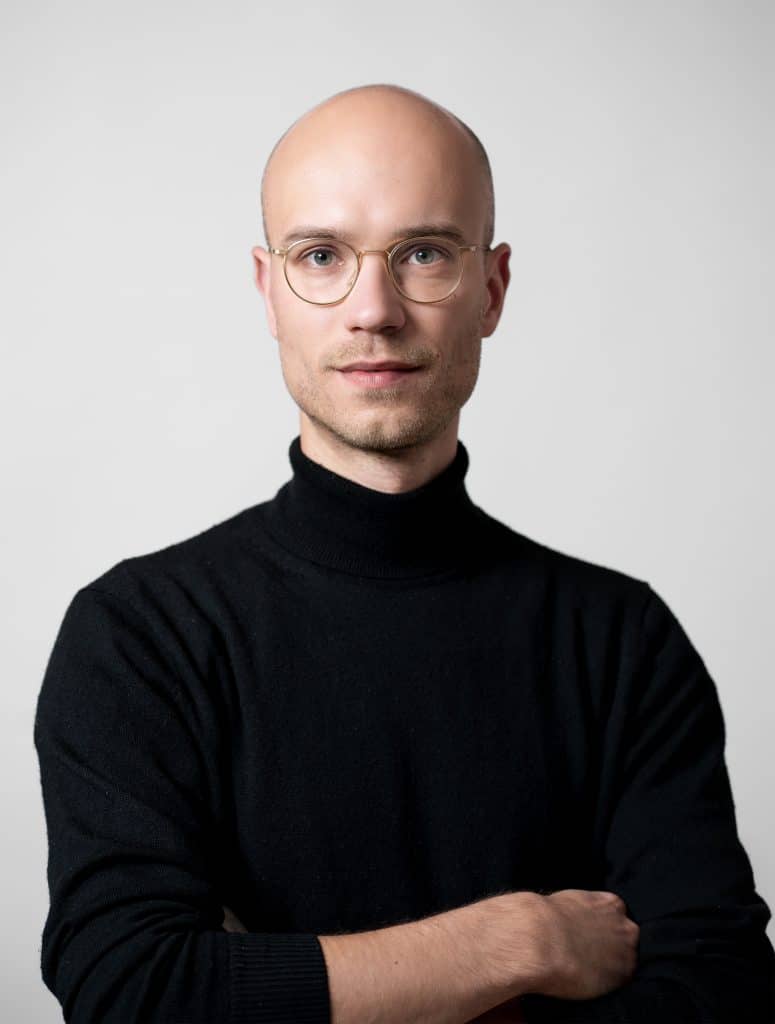
Jakob Wolfes (*1994) is Cantor and Organist at St. Jakob City Church in Zurich. He studied organ, medicine, church music, and choral conducting in Leipzig, Freiburg, and Zurich. As a concert organist and ensemble director, he is particularly committed to the performance of contemporary music. Violinist Franziska Sattler spoke with him about the fascination of the organ, performing with an orchestra, and this unique concert program.
In Conversation with Organist Jakob Wolfes
Franziska Sattler (violin): This concert is a very special one for us because it’s not every day that you get to perform with an organ—an instrument that is anything but typical in the orchestral context. We’d like to ask you a few questions. Thank you so much for taking the time!
Jakob Wolfes: My pleasure!
What about the organ do you find more exciting than other instruments?
What truly fascinates me about the organ is the contrast between, on the one hand, dealing with what is essentially a machine—an incredibly technical instrument—and, on the other hand, discovering how different every single one of these “machines” can be. I think organists are probably the only musicians who perform concerts on instruments that differ so fundamentally in size, quality, construction, and style. Every new organ opens up an entirely new musical world. You realize that the works we perform become different pieces of music in every venue. They require different musical decisions and different interpretations, and that’s what keeps them endlessly fascinating.
That’s very interesting! How do you get to know a new instrument? How do you prepare for a project or concert on a particular organ?
The first thing I do is simply examine the instrument itself: What stops does it have? How is it built? Who built it, and in what period? With a bit of experience, that already gives you a pretty good sense of the instrument. Then I start listening to it and discovering how it behaves in its particular acoustic space. Do the different stops and tone colors sound the way I expected? How do they blend together? That’s often where the biggest surprises lie.
The next step is to establish a physical relationship with the instrument—how my own body interacts with its mechanics and the way it produces sound. I want to understand what it feels like to play this particular organ, what kind of playing naturally emerges from it, and what a specific piece requires from this instrument in order to work musically. I find that especially rewarding.
Are there particular stops or tone colors that you especially enjoy?
I love it when a particular combination of stops is unmistakably associated with a composer. Take Poulenc, for example: there’s that characteristic French Romantic registration combining the slightly detuned Voix céleste and Gambe stops, creating a shimmering pianissimo. I don’t know whether it’s the most beautiful sound an organ can produce, but it’s certainly one of the most distinctive—especially when played on an authentic instrument from that period. It immediately evokes an entire musical world shaped by the repertoire written for those colors. It’s wonderful when an instrument articulates these characteristics so clearly and allows a composer’s sonic vision to be realized authentically.
At the same time, it’s equally exciting to discover sounds that deliberately avoid these familiar characteristics. That’s precisely what Bernhard’s piece is about. It asks the organ to produce sounds that simply aren’t part of the traditional organ repertoire. Stops are used in unexpected ways—for example, individually rather than in combination—creating sounds that may lack a clear fundamental pitch and strike our ears as almost mechanical, or even like computer-generated sounds. Suddenly the organ produces timbres you would never expect from a church instrument, opening up entirely new sonic worlds.
Does this contrast between the different works make the program especially compelling from your perspective?
Absolutely. On the one hand, it’s a very cohesive program, bringing together what are probably the two best-known works for organ and orchestra: Saint-Saëns and Poulenc. Both are French composers, and the pieces were written within a little more than fifty years of each other. So most of the music on the program belongs to a relatively close stylistic world, even though those decades encompass the transition from Romanticism to Modernism.
At the same time, I felt the program needed another work—one that approaches both the orchestra and the organ in an entirely different way from these established masterpieces. I think Bernhard’s piece does exactly that by giving the organ a completely different role.
Would you say that in Saint-Saëns’s “Organ Symphony,” the organ is more of a soloist or more a part of the orchestra?
Well, the organ is always the most important instrument! (laughs) Everything revolves around the organ.
But seriously, I think this is exactly where the interesting difference between Poulenc and Saint-Saëns lies. Saint-Saëns tries to integrate the organ into the orchestral texture as an important, but certainly not dominant, component. Poulenc, by contrast, gives the organ much more of a soloistic role. Even more than the evolution of musical language toward modernism, it’s the organ’s very different function in these two works that sets them apart.
What would you like audiences to take away from this concert—or from organ music more generally?
What fascinates me about combining orchestra and organ is that the organ can almost be understood as a miniature orchestra in itself. In many ways, the organ is built like an orchestra. These works therefore attempt to unite the orchestra with its own imitation—which is really quite an unusual undertaking. At first glance, it hardly seems likely to succeed, and for a long time people believed the two simply shouldn’t be combined.
What makes these three works so fascinating is that each finds a completely different answer to the same question: What is gained by combining these two sound worlds? Each composition arrives at its own unique solution. As an organist, I think that’s one of the most exciting aspects for listeners.
Another remarkable feature is the sheer physical distance within the ensemble. I sit a very long way from, say, the concertmaster. Yet communication still reaches all the way to the furthest pipes of the organ. Watching—and hearing—how this works despite the enormous distances, how the acoustics become almost three-dimensional, is something audiences can experience with both their eyes and their ears. I think that can be a truly fascinating and rewarding part of the concert experience.
Thank you very much! We’re very much looking forward to performing with you!
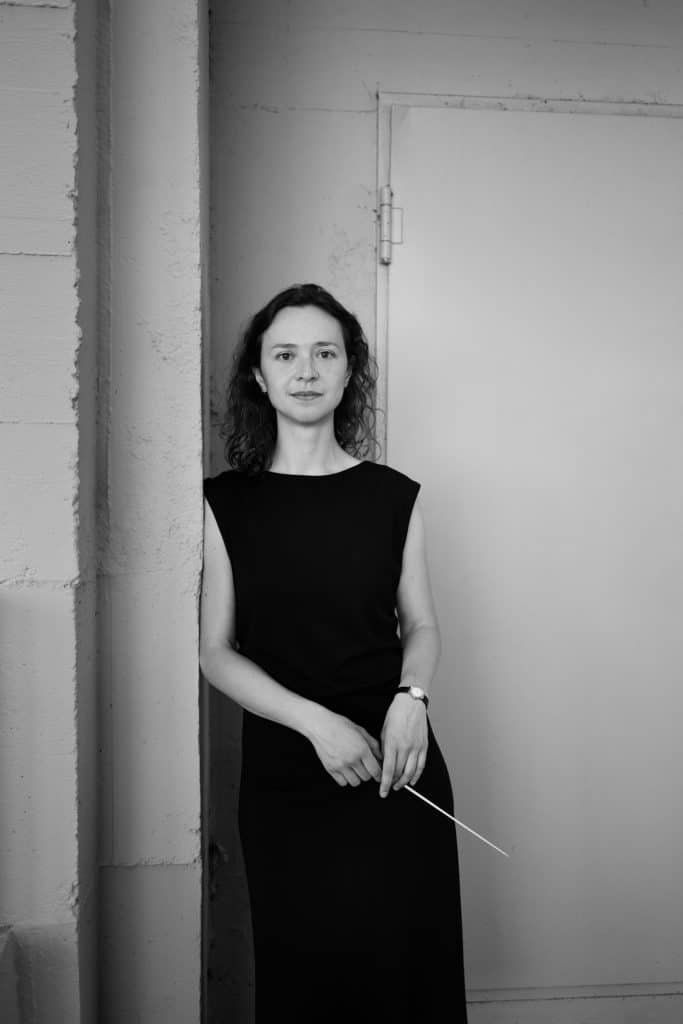
Originally from Stuttgart, conductor Ina Stoertzenbach has served as Music Director of the Abaco Orchestra Munich since the 2024–25 season.
Earlier this year, she worked as Assistant Conductor at the Baden State Theatre Karlsruhe for the production of Poulenc’s Dialogues des Carmélites. During the 2023–24 season, she was the Humperdinck Fellow of the Neubrandenburg Philharmonic, where she conducted productions of Bastien und Bastienne as well as performances of Der Freischütz, Die Fledermaus, and Ein Walzertraum. She returned to the Neustrelitz State Theatre the following season to conduct two revival productions. In the summer of 2023, she served as Musical Assistant and Vocal Coach at the Heidenheim Opera Festival for Verdi’s Don Carlo and Giovanna d’Arco.
Stoertzenbach was also a conducting fellow at the Conducting Academy of the Bergische Symphoniker. She has collaborated with ensembles including the Stuttgart Philharmonic Orchestra, the orchestra of Munich’s Gärtnerplatz State Theatre, the North German Philharmonic Rostock, and the Orquestra Simfònica de les Illes Balears.
She is deeply committed to developing innovative concert formats and expanding music education and community engagement. She has led projects with the German National School Music Orchestra (Bundesschulmusikorchester), the Young North German Philharmonic, and the Young Ensemble Berlin.
In April, she assumed the music directorship of the German–French–Hungarian Chamber Philharmonic of Forum Bayreuth. After studying music education and church music, she recently completed her graduate studies in orchestral conducting at the University of Music and Performing Arts Munich (HMTM), where she studied with Marcus Bosch and Georg Fritzsch. During her studies, she received both the Women’s Advancement Scholarship and the Deutschlandstipendium from the Freiburg University of Music and the University of Music and Performing Arts Munich.
Violin I
Ben Balschbach
Lisa Beer
Janna Buring
Carla Klein
Felicitas Marxer
Louise Platen
Bärbel Rehm
Franziska Sattler
Magdalena Schlobohm
Annette Thurau
Andreas Wittmann
Violin II
Katharina BömersAmelie Ebke
Johannes Ebke
Julian Hirschmann
Friederike Horn
Santiago Kuhl
Johannes Kunz
Anne Schweikl
Julian Winnetou Sosa
Rebecca Thurner
Jennifer Wladarsch
Viola
Levan Dornis
Manuel Egg
Nicolai Arne Engel
Sofie Grimm
Tanja Karl
Veronika Leibl
Julia Neumann
Julia Schmidt-Rohr
Tizian Schuhbeck
Dorothea Seydel
Regina Vernaleken
Cello
Juliane Ahrens
Jakob Biesterfeldt
Florian Bömers
Anna Groesch
Leonie Mauch
Laura Oßwald
Lukas Schamriß
Melanie Schulz
Double Bass
Dagmar Blaumer
Hubert Krammer
Markus Pflanz
Ana-Marija Sentic
Flute
Carola Bartels
Mathilde Navarri
Luisa Schürholt
Maya Wehrmann
Oboe
Franziska Ketter
Gustav Berger
Marc Megele
Clarinet
Eve Georges
Michael Lecointe
Julian Moissl
Bassoon
Thilo Goecke
Miriam Hampe
Clara Minkus
Horn
Andreas Raupach
Daniel Scherer
Michael Schöne
Bastian Urbansky
Trumpet
Moritz Beck
Julian Grote
Franz Noack
Trombone
Lucas Heidemann
Valentin Heumann
Ludger Steens
Tuba
Kristin Lakatos
Timpani
Maximilian Schinke
Percussion
Tristan Vauth
Dominik Keim
Piano
Elias Lorenz
Veronika Peulic
The Abaco Orchestra
For more than 37 years, the Abaco Orchestra has been one of Munich’s leading community orchestras, proving year after year that outstanding music-making extends far beyond the city’s professional ensembles. Around 100 passionate musicians—students and professionals alike, many of them prize winners of the prestigious Jugend musiziert competition or former members of Germany’s state and national youth orchestras—rehearse together every week to bring symphonic, captivating, and inspiring music to life. Final preparations for each concert take place during an intensive rehearsal weekend at Baumburg Monastery in the Chiemgau region. The result is a series of well-attended concerts in venues such as Munich’s Herkulessaal at the Residenz and some of the city’s most beautiful churches.
The orchestra is entirely self-governed. Programming and the selection of conductors are decided democratically by the musicians themselves, and the many organizational responsibilities are shared across the ensemble. From planning concerts and selling tickets to organizing post-concert celebrations, everyone contributes to making the bigger picture possible. An executive committee and a committee of principal players representing every section coordinate the orchestra’s activities. This spirit of collaboration is something audiences can hear.
Over the years, the orchestra has worked with distinguished conductors including Markus Poschner, Alexander Liebreich, Olivier Tardy, Joseph Bastian, and Vitali Alekseenok. Since 2024, Ina Stoertzenbach has led the orchestra with fresh artistic energy.
The orchestra’s musical highlights have ranged from large-scale works such as Mahler’s Symphony No. 2 to crossover concerts with bands such as Donnerbalkan and Boxhead, world premieres by contemporary composers including Gregor Mayrhofer, and chamber music performances by smaller ensembles. Concert tours have also become a defining part of the orchestra’s identity, requiring exceptional commitment from its members. The orchestra has performed in Berlin, Vienna, Mallorca on several occasions, and at the French student festival FIMU in Belfort. These travels came to a halt during the COVID-19 pandemic, making the opportunity to present this summer concert in Zurich all the more meaningful.
The orchestra takes its name from Evaristo Felice Dall’Abaco, the Italian composer and cellist who served at the court of Bavarian Elector Max II Emanuel—a fitting patron for an ensemble that so vividly combines tradition with enthusiasm. As a registered nonprofit organization, the Abaco Orchestra is funded primarily through ticket sales and donations.
We would like to thank the coaches of our sectional rehearsals for their outstanding musical guidance:
Henry Bonamy
Hansjörg Schellenberger
Philipp Sussmann
…and our heartfelt thanks also go to our phenomenal conductor Ina Stoertzenbach, Cantor Jakob Wolfes and the congregation of Open St. Jakob Zurich, as well as composer Bernhard Plechinger.
Special thanks go to the Binkert family—you make our rehearsal weekends the highlight of the year!
On behalf of the entire orchestra, we would also like to express our sincere gratitude to our organizational team:
Lisa Beer
Johannes Kunz
Fabian Krieger
Leonie Mauch
Sinje Vagedes
The Abaco Orchestra is managed entirely by its members. Your donation helps us purchase sheet music, print posters, rent concert venues, and engage guest soloists.
Abaco-Orchester e.V.
IBAN: DE59700202700036398523
BIC: HYVEDEMMXXX
HypoVereinsbank München
We are happy to provide a tax-deductible donation receipt upon request.
Become a supporting member of the Abaco Orchestra starting at just €120 per year. You’ll receive an official donation receipt and two complimentary tickets for each of our concert seasons. For more information, please visit the Förderung page on our website.
Editor
Nicolai Arne Engel
Copy Editors
Jennifer Wladarsch
Regina Vernaleken
Jakob Biesterfeldt
Katharina Bömers
Tobias Lehmann
Layout
Tizian Schuhbeck
Translations
Anna Groesch
Photo Credits
Niko Pallas
Bernhard Plechinger
Jakob Schad
Dominik Zurbrügg
Advertising
Fabian Krieger
anzeigen@abaco-orchester.de